Description
Gilroy Mere - The Green Line | Adlestrop - new double CD
If you purchase a CD, we're happy to provide a Bandcamp download code — just get in touch:
__________________________________________________________________________________________________
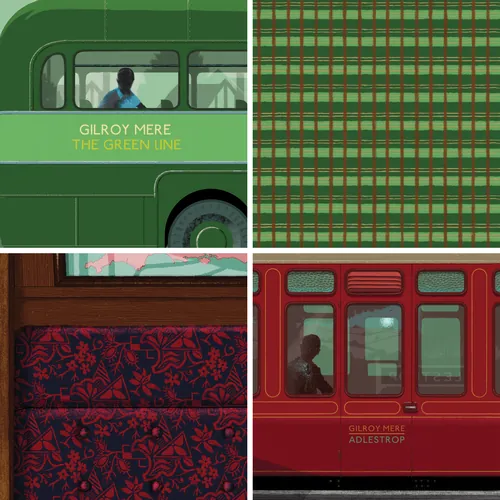
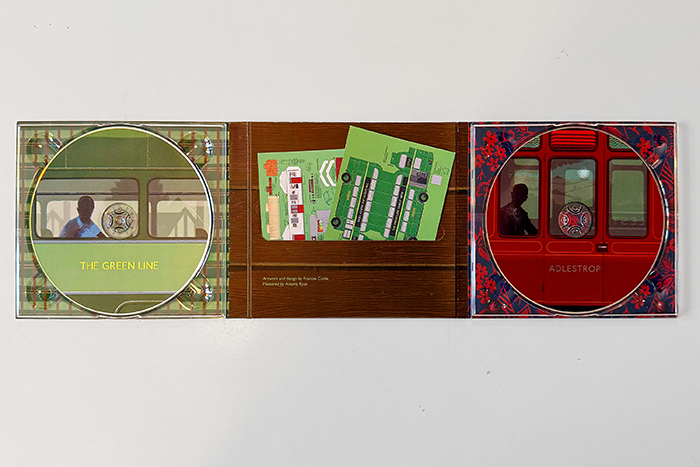
Previously only released on vinyl. Two Glass Mastered classic Gilroy Mere CDs in a six-panel digipak. With a miniature cutout and make bus and station.
The Green Line
The Green Line is an instrumental album inspired by the buses that once linked central London to country towns. Established by the London General Omnibus Company in the 1930s, with their striking green livery they were a common sight in the outer London suburbs. Between 1957 and 1960 there were 36 million journeys made a year, but by the 1970s numbers started to decline, and in1986 the service was deregulated for privatization and the buses disappeared from our streets.
“As a suburban child growing up in South London I saw red buses going into town and green buses going out. The Green Line ferried Londoners out to Kent, Sussex and Box Hill. My road felt like the border between town and country.
The houses, detached and semi-detached had names and were all red brick, mock Tudor or 1930s “moderne”, and they flickered past on our way to days out in the endless summers that are childhood: ...Windward, Fairisle , High Trees, Dunroamin’, Chez Nous, Woodlands, Hillcrest. Hillside , The Laurels. Sunnyside , The Beeches, Springfield , Fairview, Wayside, Oaklands, Treetops. Rose Bower, The Old School House……
The Green Line is written as a remembrance of childhood trips into the exterior via the green double and single decker buses that took Londoners out to the countryside. It was recorded at my home studio in Sussex using a collection of instruments and obsolete electronics amassed over a lifetime of being unable to resist junk shops, charity shops and car boot sales.
The pieces on this album represent sights, sounds and stops on a trip by a suburban English boy into the home counties. The entire record was conceived as a journey. It starts in London suburbia, and then heads out to the Weald or the Downs until you can see the sea, (via the RLH48 a real bus – currently preserved in the London Bus Museum) until at some unnamed village green, with a mossy bench and a churchyard with an ancient yew tree, we turn for home.”
Oliver Cherer
Adlestrop
Inspired by the remains of the rural railway stations, that were closed in the wake of the 1963 Beeching Report.
“This record started with Edward Thomas’s poem Adlestrop and a chance visit to the village that it takes its title from. I wanted to see the station, but found it was no longer there, all that remains is the old platform sign Adlestrop, now part of a local bus shelter. However as I walked around the village I was struck that; “all the birds of Oxfordshire and Gloucestershire” were still singing away - like ghosts from Thomas’ verse.
Visiting Adlestrop spurred me to get hold of a copy of the Beeching Report which, in Appendix 2, lists all the services and stations recommended for closure in the 1960s. The names read like an epic British poem, from halts to branch-line stops and stations and singular terminals for public schools, mines, ferries and even an asylum. There’s Ravenscar where a resort was planned but got no further in its construction than the station, and a hotel - the grid marked out for the roads never laid. Bethesda, a short branch line from Bangor up towards Snowdonia, was used for slate and passengers and is now just a quiet green valley, Christ’s Hospital on the old Cranleigh Line, opened with seven platforms to cope with the daily flood of pupils attending the famous school nearby which never came as it was a boarding school. Many of the stations have vanished, with just fields and car parks left in their place, some are repurposed as houses, or shops, or abandoned as artefacts of a lone-gone industrial past.
Armed with a digital recorder, and with a copy of Beechings Report as my guidebook I made notes and recordings on my travels around the country, and used them as the starting point for a set of pieces that try to capture the fading layers of history, in the areas where the stations had once stood making sure each track retains something of the real place within them. Back in my studio I reacted, improvised, and crafted musical responses to each station, trying to capture the ghosts and former lives of the stations and their imprint on the present.”
Oliver Cherer
Tracklisting
CD Album (PIPE_016_025_CD)
- Dunroamin'
- Cuckoo Waltz
- RLH48
- Hop Pickers
- A Lychgate
- On Ditchling Beacon
- I Can See the Sea From Here
- The Green Line
- Moss and Yew
- Just Turn for Home
- Appendix 2
- The Age of the Train
- Adlestrop
- Bethesda
- End of the Line (Aldeburgh)
- Just a River
- The Cranleigh Line
- Torver and Coppermines
- Christ’s Hospital
- Black Dog Halt
- Ravenscar
- Star Crossing